FAQ
Well Pump Repair & Installation FAQ
Common questions about well pumps, pressure tanks and low water pressure, answered by our North York well pump technicians.
QWhy is my well pump not turning on?
The most common causes are a tripped breaker, a failed pressure switch, a bad capacitor or relay in the control box, or a worn-out motor. A low water level in the well can also stop the pump. If the breaker is fine and you still have no water, call for well pump repair and don't keep resetting it.
QWhy does my well pump keep turning on and off?
That's short-cycling. It's usually caused by a waterlogged pressure tank, a tank with the wrong air charge, a faulty pressure switch or a leak in the system. Short-cycling burns out the motor quickly, so fixing the cause early can save the pump.
QHow do I test if my well pump is working?
Watch the pressure gauge while running a tap. The pressure should drop, the pump should start at the cut-in setting and climb back to the cut-out setting. If the pump runs but pressure doesn't rise, or it starts and stops every few seconds, the pump, switch or tank needs checking. We test voltage, amperage and the tank charge to find the fault without pulling the pump unless it's needed.
QHow can I increase water pressure on a well?
First check the basics: a clogged sediment filter, a pressure tank with the wrong air charge, or a worn pressure switch. A common upgrade is moving the switch from 30/50 to 40/60 psi, but only if the pump can handle it, and the tank's air charge then has to be reset to about 2 psi below the new cut-in. If the pump is undersized, a constant pressure system may be the better fix.
QHow long does a well pump last?
Most well pumps last about 8 to 15 years. Frequent cycling, sediment, hard or iron-rich water and an undersized pressure tank all shorten that. A properly sized tank and a working pressure switch are the best ways to extend pump life.
QShould I repair or replace my well pump?
If the problem is a pressure switch, control box part, pressure tank or fitting, repair usually makes sense. Replacement is the better choice when the motor has failed, the pump is near the end of its life, or it keeps breaking down. We explain both options and give you a fixed price before any work starts.
QWhat's the difference between a jet pump and a submersible well pump?
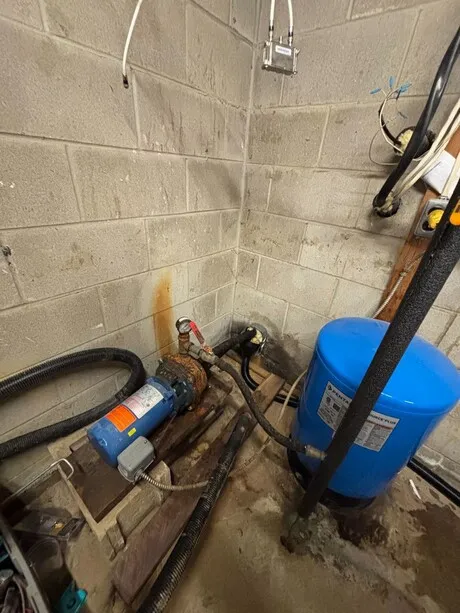
A jet pump sits above ground, usually in the basement or a pump house, and pulls water up from the well. It's common on shallow wells. A submersible pump sits down inside the well and pushes water up, which suits deeper wells and is quieter. We repair and replace both types.
QHow do I prime a jet pump?
Turn off the power, remove the priming plug, fill the pump and suction line with water, replace the plug and turn the power back on. You may need to repeat it once or twice. If the pump keeps losing prime, there's usually an air leak in the suction line or a failing foot valve that needs repair. Submersible pumps don't need priming.
QHow much does well pump repair or replacement cost in North York?
It depends on whether the fault is in the switch, control box, tank or the pump itself, the pump type and well depth, and whether the pump has to be pulled. We diagnose the system first and give you a fixed price before any work starts.
QDo you offer emergency well pump repair near me?
Yes. If you have no water, call us 24/7. We serve well properties in North York and the northern GTA, and we'll tell you on the phone what to check while we're on the way.